Technology Builds Fortunes

ED-AS268_Gordon_G_20140602142919

The great growth of fortunes in recent decades is not a sinister development. Instead it is simply the inevitable result of an extraordinary technological innovation, the microprocessor, which Intel INTC in Your Value Your Change Short position brought to market in 1971. Seven of the 10 largest fortunes in America today were built on this technology, as have been countless smaller ones. These new fortunes unavoidably result in wealth being more concentrated at the top.

But no one is poorer because Bill Gates, Larry Ellison, et al., are so much richer. These new fortunes came into existence only because the public wanted the products and services—and lower prices—that the microprocessor made possible. Anyone who has found his way home thanks to a GPS device or has contacted a child thanks to a cellphone appreciates the awesome power of the microprocessor. All of our lives have been enhanced and enriched by the technology.

Read More Here…

The Computer Language for Everyman

RV-AN451_BASIC_G_20140516173359

A bit over fifty years ago, in the spring of 1964, in the basement of College Hall at Dartmouth College, the world of computing changed forever. Professor John Kemeny, then the chairman of the mathematics department at Dartmouth and later its president, and Mike Busch, a Dartmouth sophomore, typed “RUN” on a pair of computer terminals to execute two programs on a single industrial-sized General Electric “mainframe” computer. The programs were written in Basic (Beginner’s All-purpose Symbolic Instruction Code), a fledgling computer language designed for the everyman, by Prof. Kemeny, Professor Tom Kurtz and a team of eager students.

Back then, using a computer was almost exclusively the privilege of a select minority of scientists and engineers who were conversant in the early languages of assembly code and Fortran. Prof. Kemeny, who had been a programmer on the Manhattan Project for Richard Feynman and an assistant to Albert Einstein, and Prof. Kurtz, a former student of the computing pioneer John Tukey, saw great potential in computers for advancing teaching and research, but they realized that this would require a whole new level of accessibility.

Read More Here…

Terrorism on the March

ED-AS279_edp060_G_20140603191544

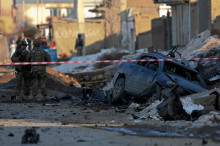
Many think terrorism is on the run. It is not. The number of al Qaeda and other jihadist groups and fighters are growing, not shrinking. U.S. disengagement—or even risking the return of terrorists to the field by freeing them from detention—is not the answer to the threat they pose. Instead, U.S. strategy should be revamped, prioritizing American interests and developing a more effective, light-footprint campaign.

According to new data in a RAND report, from 2010 to 2013 the number of jihadist groups world-wide has grown by 58%, to 49 from 31; the number of jihadist fighters has doubled to a high estimate of 100,000; and the number of attacks by al Qaeda affiliates has increased to roughly 1,000 from 392. The most significant terrorism threat to the United States comes from groups operating in Yemen, Afghanistan, Pakistan and Syria. Moner Mohammad Abusalha, an American who was a member of the al Qaeda affiliate organization al-Nusra, blew himself up in Syria on March 29.

Read More Here…

Out of the Ashes

GG OOTA BTJ

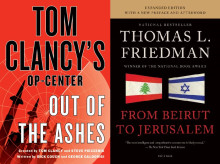
When we came up with the high concept for Out of the Ashes we did our due diligence and read all we could about the region. A few books stood out as invaluable to our work. One of the key ones was Tom Friedman’s From Beirut to Jerusalem. Here is some of the praise this book has garnered and why it guided our writing:

If you’re only going to read one book on the Middle East, this is it.”—Seymour M. Hersh

One of the most thought-provoking books ever written about the Middle East, From Beirut to Jerusalem remains vital to our understanding of this complex and volatile region of the world. Three-time Pulitzer Prize winner Thomas L. Friedman drew upon his ten years of experience reporting from Lebanon and Israel to write this now-classic work of journalism. In a new afterword, he updates his journey with a fresh discussion of the Arab Awakenings and how they are transforming the area, and a new look at relations between Israelis and Palestinians, and Israelis and Israelis. Rich with anecdote, history, analysis, and autobiography, From Beirut to Jerusalem will continue to shape how we see the Middle East for many years to come.

Helping Your Writing Shine

carrjump-master675

Writers looking for help? Evan Williams to the Rescue!

Evan Williams is at it again. Mr. Williams is sitting in an office here a mile up the road from Twitter, where he is a founder and is still a board member, working on Medium, an amorphous-sounding company that could be one more curio of the Internet age or might end up taking over the world.

So in 2012, he started Medium, a place where stories are made and read. It’s a blogging platform, and anyone can contribute, with writing on all manner of topics. The posts that gain attention, often on Twitter, are displayed prominently and gain more traction as readers and contributors weigh in. The design is responsive, meaning that no matter what you are reading on — phone, tablet or computer — it always looks pretty.

Read more here

AirSea Battle

Air-Sea-Battle-Concept6

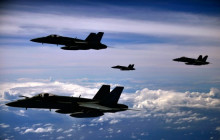
The United States Defense Strategic Guidance notes: “This country is at a strategic turning point after a decade of war and, therefore, we are shaping a Joint Force for the future that will be smaller and leaner, but will be agile, flexible, ready, and technologically advanced. It will have cutting-edge capabilities, exploiting our technological, joint, and networked advantage.”

The AirSea Battle Concept undergirds how the United States will fight and win in the face of a substantial anti-access/area-denial threat. The Joint Operational Access Concept (JOAC) describes in broad terms the vision for how joint forces will operate in response to emerging anti-access and area-denial security challenges. Due to three major trends – the growth of anti-access and area-denial capabilities around the globe, the changing U.S. overseas defense posture, and the emergence of space and cyberspace as contested domains – future enemies, both states and non-states, see the adoption of anti-access/ area-denial strategies against the United States as a favorable course of action for them.

Read more about AirSea Battle and where it plays in our national security on the Defense Media Website here

TODAY marks the 100th Anniversary of the beginning of World War I. My friend and colleague, Dr. Ed Whitman, and I share the opinion that World War I was the greatest misfortune that ever befell Western civilization. His insightful analysis follows:

article-0-1D8F4D1E00000578-368_964x717

The lamps are going out all over Europe; we shall not see them lit again in our lifetime.

Sir Edward Grey (1867-1933)

(remark, 3 August 1914, on the eve of Britain’s declaration of war against Germany)

The War was decided in the first twenty days of fighting, and all that happened afterwards consisted of battles which, however formidable and devastating, were but desperate and vain appeals against the decision of Fate.

Sir Winston Churchill (1874-1965)

(Preface to Spears, Liaison 1914)

Napoleon had said it was rare to find generals willing to fight battles. The curse [of World War I] was that so few could do anything else.

T. E. Lawrence (“of Arabia,” 1888-1933)

(The Science of Guerilla Warfare)

When every autumn people said it could not last through the winter, and when every spring there was still no end in sight, only the hope that out of it all some good would accrue to mankind kept men and nations fighting. When at last it was over, the war had many diverse results and one dominant one transcending all others: disillusion.

Barbara Tuchman (1912-1989)

(The Guns of August, “Afterward”)

Although many consider the opening act of World War I to be the assassination of Austrian

Archduke Franz Ferdinand at Sarajevo – its centennial was just a month ago (28 June) – the first actual declaration of war took place a hundred years ago today, when Austria-Hungary initiated hostilities against Serbia, after the latter rejected a draconian Austrian ultimatum intended to give Austria a free hand in bringing Franz Ferdinand’s killers to account. As a result, Russia – self-appointed protector of the “South Slavs” – mobilized against Austria, which panicked the Germans (fearful of a two-front war against both France and her Russian ally) and so it went…

28 July Austria declares war on Serbia

1 August Germany declares war on Russia

3 August Germany declares war on France

4 August Germany invades Belgium (to attack France)

England declares war on Germany in support of Belgium

6 August Austria-Hungary declares war on Russia

Serbia declares war on Germany

11 August France declares war on Austria-Hungary

12 August England declares war on Austria-Hungary**

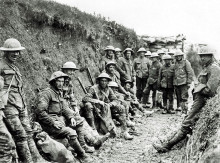
After Germany’s long-intended encirclement of Paris (under the Schlieffen plan) was thwarted by the French and British in the Battle of the Marne, the struggle on the Western Front devolved into a four-year stalemate in which the principal protagonists faced off across a line of trenches that ran from the North Sea to the Swiss border. Despite the unprecedented bloodbath that ensued, virtually no additional ground was gained by either side before the end of the conflict in November 1918.

Despite the “war-guilt” clauses of the Treaty of Versailles, which held Germany largely responsible for the hostilities and imposed extraordinary penalties and reparations, the causes of the war have been debated endlessly for most of the last century. Of the dozen or so books on the subject, two recent ones have been particularly insightful: The Sleepwalkers by Christopher Clark (Harper’s, 2013) and The War That Ended Peace – The Road to 1914 by Margaret MacMillan (Random House, 2013).

Although there was certainly enough blame to go around, it was primarily Austria-Hungary that caused the catastrophe because of her reckless determination to settle long-standing scores with Serbia.

Be that as it may… One could argue that World War I was the greatest misfortune that ever befell Western civilization. It destroyed the West’s belief in inevitable human progress. It brought down the Austro-Hungarian, German, Russian, and Ottoman empires, bankrupted France and England, and put the British Empire on the skids. It was the proximate cause of the triumph of Communism in Russia and the formation of the Soviet Union, drove the United States into two decades of international isolation, and instilled in Germany a thirst for revenge that led directly to the rise of the Nazis and World War II.\ Moreover, in the Middle East, Britain’s and France’s cack-handed and self-serving division of the remains of the Ottoman Empire was largely responsible for all the turmoil we suffer there today.

Upon learning the terms of the Versailles treaty, Germany’s deposed Kaiser Wilhelm II (1859-1941) is supposed to have remarked from his exile in Holland, “The war to end war has resulted in a peace to end peace.”


What Motivates Us?

0706GRAY-master675

What motivates us? For many that is one of life’s mysteries – and those who crack the code seem to be vastly more happy and successful.

Two highly-credentialed researchers address this question in their recent New York Times article, “The Secret of Effective Motivation.” Here’s what they say:

There are two kinds of motive for engaging in any activity: internal and instrumental. If a scientist conducts research because she wants to discover important facts about the world, that’s an internal motive, since discovering facts is inherently related to the activity of research. If she conducts research because she wants to achieve scholarly renown, that’s an instrumental motive, since the relation between fame and research is not so inherent. Often, people have both internal and instrumental motives for doing what they do.

What mix of motives — internal or instrumental or both — is most conducive to success? You might suppose that a scientist motivated by a desire to discover facts and by a desire to achieve renown will do better work than a scientist motivated by just one of those desires. Surely two motives are better than one. But as we and our colleagues argue in a paper newly published in the Proceedings of the National Academy of Sciences, instrumental motives are not always an asset and can actually be counterproductive to success.

What motives you?

Read more here…

Art Under the Umbrellas

download2

Coronado celebrates “Art under the umbrellas on Saturday August 2, 2014 from 10 AM to 4 PM at Coronado’s Spreckeles Park. Read more about this event here.

The Coronado Council of the Arts has featured my books at several previous events. An article from their recent web post here.

At this event I’ll be talking about several of my books, among them:

  • Leave No Man Behind: The Saga of Combat Search and Rescue
  • Tom Clancy Presents: Act of Valor – New York Times Best Seller
  • The Kissing Sailor – Amazon and Barnes and Noble Best Seller
  • Tom Clancy’s Op-Center: Out of the Ashes – Publisher’s Weekly Best Seller

Join us!

Write, Right

download

There are likely as many “beginning writers” as there are established writers. A few beginning writers hit pay dirt the first time. Many, many others struggle for a protracted time.

In this New York Times “Bookends” piece, two established writers, Anna Holmes and Leslie Johnson answer the important question: “When you started out, was there anything you used to do as a writer you now regret?” Just to whet your appetite:

Anna:

I regret many things, including, but not limited to:

  • Inserting myself into reported narratives where I didn’t belong.

  • Crafting long, complex sentences that I thought made me sound intelligent and sophisticated.

  • Assuming that aggressive, masculine-sounding prose was the ideal style of writing because it was so frequently rewarded in my literature and composition classes.

  • Taking too long to get to the point.

Leslie

When I started writing autobiographical nonfiction, I was mainly using these early slivers of memoir to purge all kinds of guilt and self-loathing and shame. I was writing almost exclusively about the parts of myself I liked least — or the situations I most regretted. These were the aspects of my life that carried the most urgency, and I was convinced that confessing them was the only way to achieve a sense of authenticity — to escape the trap of self-aggrandizement. They were the ragged edges, the loose threads. I wanted to follow them. I felt an urge to articulate every notion or impulse I’d ever had. I thought this would earn my readers’ trust. I wouldn’t make myself look good, and — in this refusal — I would make myself look honest. But it usually turned out more like this: I just made myself utterly unlikable.

Read more here